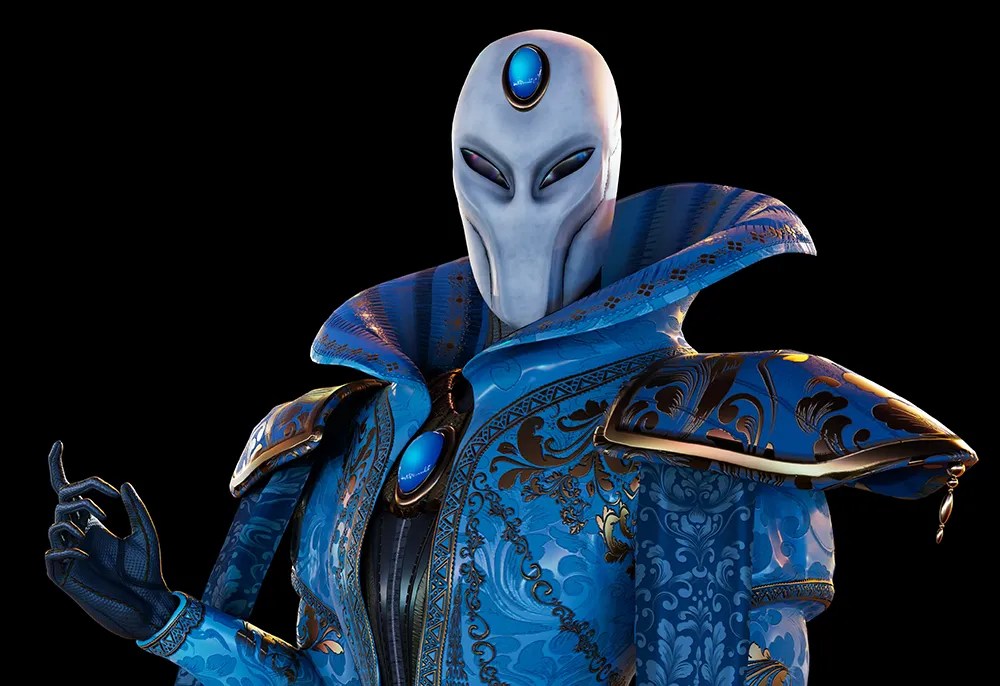
In the Director’s Cut of Something by the River, I introduce a new character called Archimage Te-Vis. Te-Vis is a Zurxok, and as an Archimage, represents the shadowy leadership of the Illusionists. In the first four books of the Z-Verse, Xa-Kol’s interactions with the Archimages are quite limited, barring her own mentorship as a youth under the tutelage of the renegade Archimage, Vae-Nu. In writing Something by the River: Director’s Cut, I quickly realised that the story needed a darker authority figure. Archimage Te-Vis is that figure.
Introducing Archimage Te-Vis
Archimage Te-Vis is a very different character to Illusionist Xa-Kol, and in fact, many of the Zurxok characters we have seen prior to this point. In the ancient past of the Circle of Illusionists, Illusionists were storytellers, messengers, and record-keepers. Their role was to travel near and far, spreading knowledge to the various courts of the Zurxok. Over time, advances in technology and the emergence of a cutthroat meritocracy have resulted in the Illusionists becoming an intelligence organisation. Beneath the surface of tradition lie the complex mechanisms within the uppermost echelons of the Circle, secrets that are not shared even with senior Illusionists such as Xa-Kol.
In many ways, Illusionist Xa-Kol is the idealistic view of what an Illusionist is: curious, friendly, and highly community-oriented. Archimage Te-Vis embodies the reality. She is cool, unsympathetic, and her true motives are unknown. Even her loyalties are ambiguous, as the Circle is the sum of its many parts. A single Illusionist is an expendable asset. The mission is what matters. Traditional values are nice-to-haves.
Character design and backstory
Like most Zurxok, Archimage Te-Vis wears a mask. Illusionists only rarely take theirs off. Each mask is unique, its design carrying special significance. Te-Vis’ mask reflects both her lofty rank and her demeanour. The mask is pale, almost porcelain, and the narrow eyes and elongated face are meant to convey both beauty and something unsettling. It also calls to mind the typical image of the ‘alien grey’, which is a design the Zurxok do borrow from.
Like Xa-Kol, Te-Vis wears a very detailed costume, though it is understandably far more ornate given her stature as an Archimage. I wanted something that had a very strong silhouette, with stately shoulder pads and an enormous collar that frames the face. She needed to have considerable physical presence without making her look like a soldier.
Creating the concept in Procreate
My sketch was made quickly in Procreate. When working in a team or in-house, concept art’s goal is to describe an idea thoroughly. Why? Because the artwork will eventually be handed off to a 3D artist, who might themselves hand it off to a texture artist. If the concept is to be rendered faithfully in 3D, then that concept art needs to be fully understood. Since the Z-Verse and Crosshollows are both solo projects, it means I get both the privilege and responsibility of making all design decisions myself (and executing them myself, too).

These days, a lot of my concept sketches for matte paintings, characters and objects are extremely simple and fast. I just need to know the broad strokes of what I intend to do, and then I can develop things as I go along. As you can see, the reference artwork for Archimage Te-Vis is not highly rendered at all. I had a solid idea of the shape of her mask, the colours I would use for her outfit, and the shape of her splendid coat. I knew that I wanted very detailed fabric work on the coat. Since I am both the sculptor and texture artist on this job, there was so reason to spend time creating a high-fidelity drawing of those patterns.
The freedom I have as a solo creator is I can develop things as I go, change direction, or expand on something. I don’t need to communicate anything to anyone else, just to myself. In general, whether concept art is in-house or done solo, I think a major goal is efficiency. We want to get an idea across quickly and be ready to pivot if we need to.
Building the character model in Maya and ZBrush
Once I had the concept down, I moved into Maya. My process for 3D is quite old-school. I prefer to start low-poly and then export into ZBrush to create a high-poly sculpt that can be exported and then baked into a normal map. All of the major species in the Z-Verse have existing base meshes, which I then duplicate and sculpt in order to create a bespoke character model. I created those base meshes myself, of course, and that labour pays for itself down the line since it enables me to get started quickly on any number of characters.
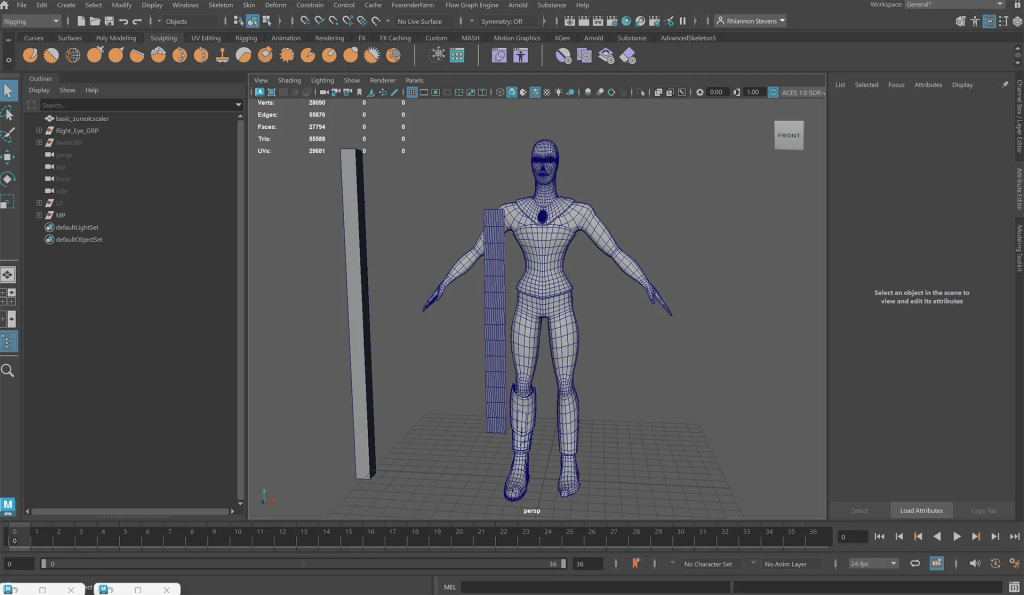
While Te-Vis may only have a relatively small role in this particular game, I’m not creating her exclusively for this project. Once completed, her model becomes another asset in my growing library of Z-Verse characters, ready to be used wherever the stories might take her.
Te-Vis is taller than most other Zurxok encountered so far, including Xa-Kol. Though her face is not seen in-game, I am a perfectionist and modelled and textured her along with her clothing and mask. She has a much harder, harsher appearance than Xa-Kol.
I like to start low-poly because it enables me to create the basic shapes quickly, regardless of what I am modelling. It also means I can deal with the UV mapping as I go along. Once I have a solid low-poly base mesh for the character and their clothes, I export it as an FBX and bring it into ZBrush. It’s at this point that I will start refining the shape through sculpting. Once I am happy with the shape, I export two versions: one ultra high-poly model that is strictly for baking normal maps, and the other a lower subdivision model that will be the ‘final’ mesh.

Developing textures and materials for a 3D character
I absolutely love texturing, and it is my favourite part of the process. This is the stage where I bring a character into Substance Painter, bake a normal map from my high-poly sculpt, and begin bringing it to life with textures. This is the part of the character design process where I paint skin, pores, and wrinkles. Since Te-Vis will not (yet) be seen without her mask, I didn’t spend as much time texturing her skin as I would have liked, since I time boxed myself, but I still did some basic painting that I can revisit later (and this is something else I like about texturing, it is very easy to go back, paint some more, and simply re-export the maps without affecting the rigging or weight painting).
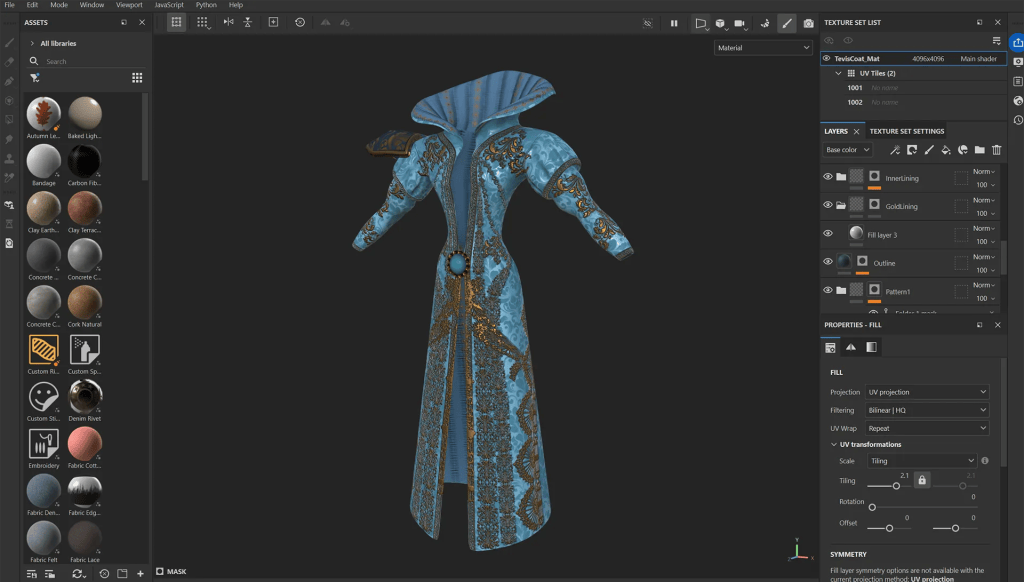
As for her clothes, this was, of course, very fun to paint. The layers of her coat comprise the foundational leather material, followed by the inner lining, then the brocade, and finally, the gold embellishments placed on top. Substance Painter then exports PBR-ready materials for me that I can bring into Maya. The elaborate blue-and-gold patterns, particularly the contrasting fabrics and embroidered-looking details, suggest someone whose position affords extraordinary luxury. There’s a lovely interplay between the relatively restrained mask and her extravagant costume.
Rigging, weight-painting and rendering the character
Since I don’t use my characters for animation, I have a lot of leeway when it comes to rigging, which is the process by which we give characters a skeleton and controllers. For many years, I have relied on AdvancedSkeleton, a plugin for Maya that helps automate the majority of the rigging process. I simply place joints of a humanoid skeleton where required (adding another finger joint chain for Te-Vis, given that Zurxok have six fingers), and then let the plugin do the rest. I rig the eyes separately, using an aim constraint and a custom controller.
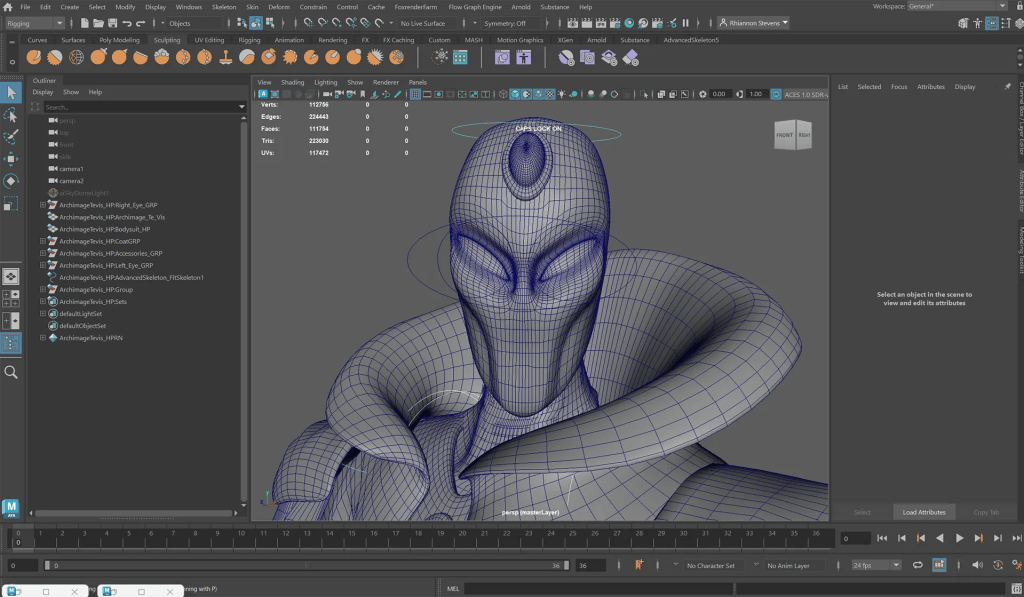
As for weight painting, I do hear a lot of people complaining about this part of the process, but I personally don’t find it too bad. Usually, I don’t need to do too much more than fix up the weight painting around the shoulder and scapula area, and the head. The rest usually is perfect as-is. For posing, I use blend shapes to control things like the ‘flow’ of clothing or facial expressions (which, in this case, don’t matter since Te-Vis is fully masked). Finally, I light and render the character before bringing it into Photoshop for a bit of post-production where necessary.
Bringing Te-Vis into the Z-Verse

All this seems like an extensive number of steps when I write it down, but I find it well worth it, and very enjoyable. Every 3D modelled character I create is not just a portfolio piece, but can be used in a thousand different illustrations, without me having to redraw them each time. They can be placed into many different scenes and lighting setups. I can use them not just in still renders, but in animations and even games. With all this work done, Archimage Te-Vis is now the latest character to join the ever-expanding Z-Verse, enriching this xenofiction storyverse. She will next appear in Something by the River where she has an important role to play. If you have enjoyed this post, please do check out the game, which will be available for free.


