
Writing a convincing alien character still requires the same fundamentals as writing any convincing character: motives, contradictions, relationships, desires and a coherent inner life. But xenofiction asks for something more. The author isn’t simply working on a blank canvas, they are also responsible for mixing the paint.
An alien is still a character first.
I feel the risk with speculative fiction in general is to get lost in the weeds of interesting anatomy or lore. These things are important, but character comes first, always. And a good character needs goals, temperament, biases, relationships, weaknesses, fears, humour, and loves.
This is where those xenofiction elements can weave themselves in.
Normal for a character like Commander Qwatajawa might not be the same as normal for Hawke from the Crosshollows series. This is where the paint-mixing begins. A species will have biological and environmental realities that are upstream of their culture, their history, and even their technology. An author can ask themselves:
- What does this species take for granted?
- Where are the moral boundaries?
- What is their understanding of family?
- What do they consider admirable or shameful?
For me, I find that I often start with a character and the broad strokes of a species at the same time. It’s not so much that I design an encyclopedia and then create a character from this lore as I create a character and then ask myself, ‘Where do they push? Where are they pulled?’
Biology matters, but it isn’t (always) destiny
A species can share biological tendencies without every member behaving identically. For example, Commander Qwatajawa, who I mentioned previously, is a Rej-Jir. Her species have the in-universe stereotype of being grandiose, quite ruthless, passionate, and arrogant as a rule. Qwatajawa, on the other hand, is the ‘straight man’ of the Z-Verse. She’s incredibly mild-mannered and enormously polite, to the point that I have a convention when writing her of not giving her contractions in her speech. She is also very quiet.
To Rej-Jir, Qwatajawa is viewed as someone rather odd, a perfectly competent female who is peculiarly uninterested in climbing the ranks. On the other hand, other members of Qwatajawa’s squad embody aspects of the stereotype at different volumes. Ultimately, my favourite examples of xenofiction lean away from the idea that every member of X group has the same personality and goals, which, to me, is neither interesting nor particularly true to life.
Familiar emotions don’t automatically make a character human.
Grief, friendship, ambition, jealousy or affection are not uniquely human emotions. We know that many non-human species right here on earth feel social bonds, get lonely, bored, stressed, and seek play. Anyone who has a pet will likely have countless stories demonstrating that their furry (or feathered) friend has a personality. Someone is home.
What makes these emotions alien could be how and why they arise, how they’re interpreted, how they’re expressed, and what their society thinks of them. In my Crosshollows series, Arcadians are known to be intensely possessive, acquisitive, and prone to jealousy in the extreme. Arcadians do not interpret these emotions negatively, and, in fact, these passions are encouraged as natural extensions of their love of treasure.
What might be regarded as an undesirable character flaw in one culture can therefore become an expected expression of attachment in another.
Character Study: Ambassador Sa-Kolis
Ambassador Sa-Kolis is the protagonist of my novel, Triangulus, as well as the short story Escape from Angra-Mainyu. Sa-Kolis is one of my favourite characters to write because she gives me a cynical voice from inside the Z-Verse itself. A cynical and frankly rude person, Sa-Kolis is a joy to write because she provides an alternate perspective on the structures and beliefs that underpin the Z-Verse.
Characters like Commander Qwatajawa and Hawke, from the Crosshollows series, are ultimately comfortable within their respective societies, and work to uphold them, elevate them, and, in Hawke’s case most especially, adulate them. Sa-Kolis is different. Though not a lawbreaker, and, in fact, an enormously ambitious person, she has no illusions about the world she has come from. Sa-Kolis has little problem pointing out the problems both at home and abroad, so to speak, and so she provides a richness to the overall setting by casting a light on its darker corners.
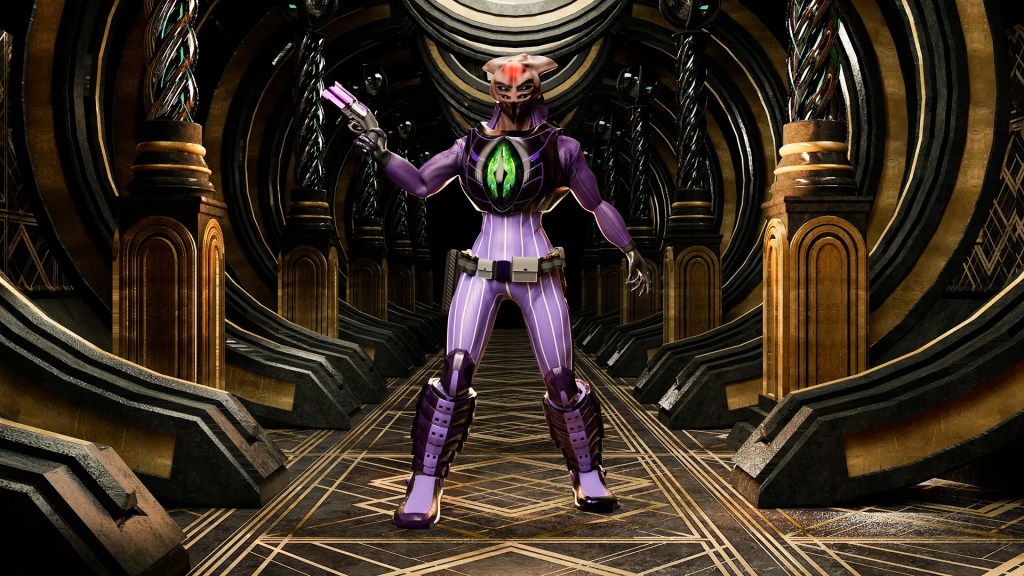
In terms of xenofiction, Sa-Kolis very heavily embodies the idea that biology is upstream of culture, social conventions, and the people who arise from said culture. Sa-Kolis’ people, the Rit-Phyr, are in fact a species of two. The Rit are a humanoid, intelligent, and highly competitive people.
When they come of age, they merge with a symbiote species known as the Phyr, slug-like creatures who attach themselves to the Rit’s body, in a lifelong bond that grants the Phyr protection and the Rit enhanced strength, longevity, and a sort of low-level empathy. Some Rit are genetically unable to bond with a Phyr.
These unlucky few are known as vitiates, and are subject to deep distrust and even hatred by the rest of the population, who view them as a threat to a harmonious Rit-Phyr society. Because these vitiates are pushed to the peripheries of society, they are enormously overrepresented among the criminal population, which has only deepened their marginalisation. Sa-Kolis is among this group.
In writing Sa-Kolis, I have consciously avoided the familiar tale of a disadvantaged character who fights boldly for the rights of their group. Sa-Kolis is more alien, and more complex, in her reaction to her situation. Despite her status as a vitiate, Sa-Kolis has attained a prominent position in Rit-Phyr society through grit and force of will. She takes kindly to neither pity nor sympathy, and has very little of either for her fellow vitiates who eke out a miserable existence on the fringes. “Their choice,” Sa-Kolis says. “I managed the climb. Why can’t they? They’re just as useless as it is said.”
This harsh and uncompromising viewpoint is something very strongly rooted in the fact Sa-Kolis is a Rit. The arachnid-like characteristics of these people are not simply aesthetic. I’ve envisioned a species that has, for much of its pre-spacefaring history, existed in a society that is equally harsh. The domineering and often cruel matriarchy which prevailed in the past saw the smaller males segregated and subjugated, while only the most ruthless females rose to power.
The civilisation of the Rit-Phyr is fascinating, beautiful, and brutal, and I used that understanding of the species to inform Sa-Kolis. Sa-Kolis is impolite, often downright mean, as well as deeply feeling and committed to her principles. Her backstory, appearance, and outlook could not easily exist outside of xenofiction, because they derive completely from the blank canvas that I mentioned.
Sa-Kolis does not need to be incomprehensible to be alien. I want the reader to understand exactly why she thinks as she does, even when they disagree with her. The alienness comes from the biological and cultural chain of cause and effect that produced her worldview.
Alienness has to serve the story.
Not every sentence has to be maximally strange. Sometimes, comprehensibility matters more. It’s not about winning an ‘alien enough’ contest. One thing I’ve mentioned in a few of my other blog posts, and I will continue to reiterate, is that there is no point in writing and drawing things that you, as the author, neither understand nor connect with. That might be a nice thought exercise for a one-shot story or single image, but it will become exhausting and difficult when the goal is to create a larger body of work.
For me, I just adore writing and drawing my characters, and I will happily spend all of my free time doing it. This flow state is simply not possible when you have the friction and anxiety that comes with asking, ‘Yes, but what if it’s too comprehensible?!’ Write what you are passionate about, foremost.
For me, that is ultimately the pleasure of xenofiction. The canvas may be blank and I may have to mix the paint myself, but once I know the colours I am working with, I can stop worrying about whether they are alien enough and simply paint.


