With A Binding Unmade: Prologue now released, I wanted to take some time to talk about how this little hidden object adventure came together, specifically the hidden object game art and atmosphere.
This project began as a way to introduce players to A Binding Unmade, the upcoming full-length hidden object game set in the Crosshollows universe. I wanted the prologue to stand alone as its own small mystery, while also offering a glimpse of the atmosphere, characters, and strange Arcadian magic that will shape the larger game.
One of the first major pieces of the project was the artwork.
For me, the visual side of the Crosshollows, and indeed, any story, is central. I have worked as a UI designer for many years, and I have often navigated the user experience of a project by devising its visuals. As for the Crosshollows, the setting lends itself to the hidden object genre very nicely. This is a setting of glimmering crystals, abandoned manors, and a science-fantasy setting where almost anything goes.
In a hidden object game, aesthetics are paramount. Things have to look nice, but also invite searching.
Creating hidden object game backgrounds

The challenge was finding the balance between richness and readability. Hidden object scenes are at their best when they feel full of detail, but not so crowded that the player feels punished for exploring them. I wanted each room to feel like a real place with its own history, while still making sure important objects, clues, and puzzle pieces could be found without frustration.
The manor setting gave me a lot to play with. It let me lean into romantic decay, Arcadian ornamentation, strange little details, and the feeling that something beautiful had been interrupted. The goal was not just to create a backdrop, but to make every room feel like part of the story.
To create the artwork, I used a combination of 3D renders and matte painting. The characters and the base layouts of the rooms were all created in Autodesk Maya, and then textured. For characters, a combination of ZBrush and Substance Painter is used. I typically sculpt a high-poly version of the character and then bake the normals in Substance Painter when I do texture work.
My art pipeline
I seem to be a little old-school with regards to my pipeline. In the industry, typically artists will be inside ZBrush first, sculpting without concern for topology. It is really an extension, I feel, of the concept art phase, where artists are letting their imaginations soar. For me, I prefer the methodology of leaving concept art in the 2D world. Once I’m in 3D, I have already settled on a look and I block it out with basic topology first. Once I have the low-poly ready, I bring it into ZBrush to kick it up a notch.
- 2D concept art first
- Low poly character model
- High-poly character sculpt
- Normals baking and export of one or two subdivision higher than the low-poly
- Texturing
- Rigging. In my case, I use the Advanced Skeleton plugin. Once the model is rigged, weights are painted
- And the wonderful (horrible) process of creating and arranging hair cards
Because I use my models in still images, I have a lot of leeway when it comes to sculpting after posing, or even painting over digitally in Photoshop if I want to make a few tweaks.
As for environments, this is an ongoing issue for me. I really am not very good when it comes to architecture or vehicles. It’s something I know I have to keep practicing on, and of course, it results from the fact I am so character focused.
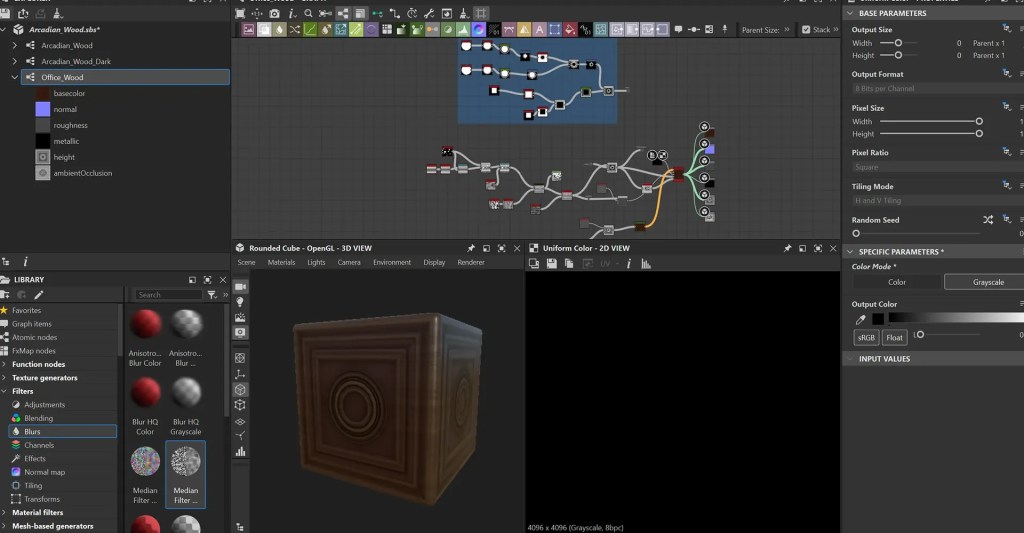
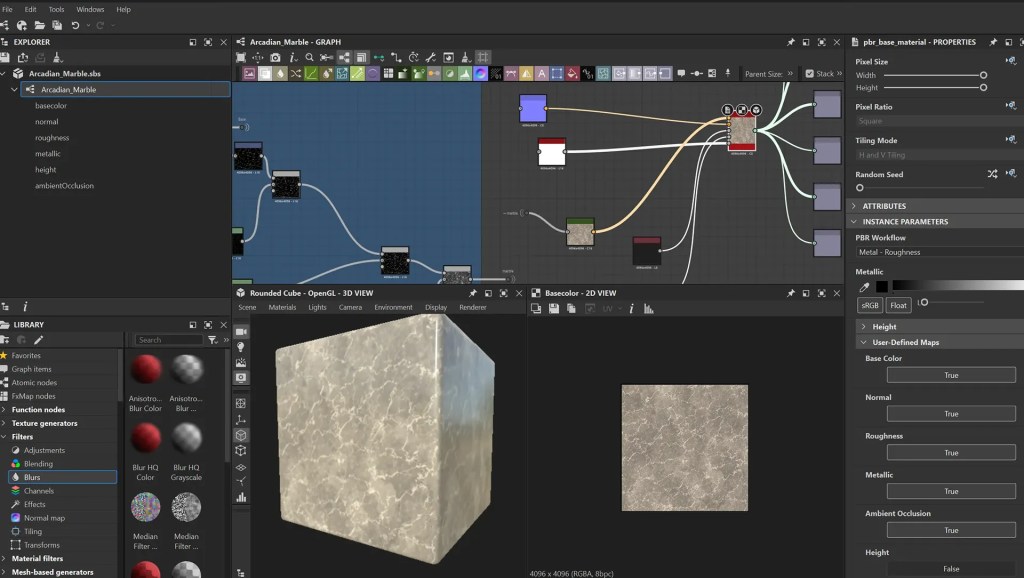
As part of designing the environments, I spent more time inside Substance Designer. This allows me to create custom textures using a graph of nodes. This is a non-destructive and very flexible workflow that allows me to build a large library of textures that are ‘Arcadian specific’.
Getting stuck into coding with GDScript
Coding was one of the biggest learning curves of the project. I had worked on visual novel material before, but A Binding Unmade: Prologue needed more systems: clickable hotspots, inventory items, journal entries, puzzle states, scene transitions, hidden object logic, save functionality, UI panels, cursor behaviour, and all the small pieces that make a game feel complete rather than merely functional.
A lot of the development process involved building something, testing it, breaking it, fixing it, and then realising I needed a cleaner version of it for the next scene. The hidden object framework grew gradually. First came the basic search-and-click structure, then the puzzle gates, then the journal and inventory, then the polish elements that made the experience feel smoother.
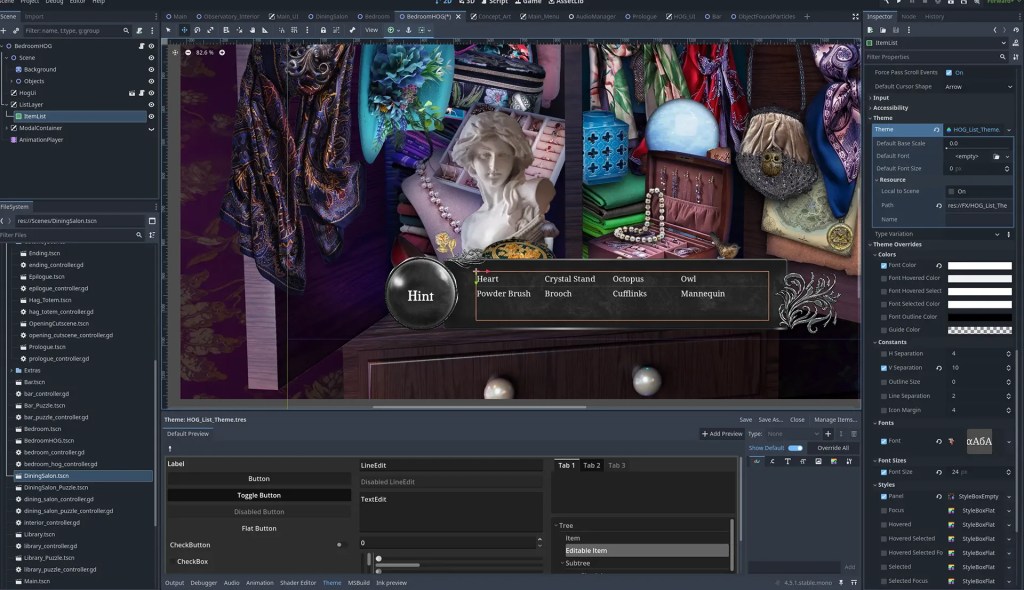
Some of the trickiest parts were not the big dramatic systems, but the small bits of player experience: making sure the cursor behaved properly when hovering over hotspots, making sure UI panels did not clash with each other, making sure the player could not accidentally click through overlays, and making sure the game remembered what had already been collected or solved.
Those are the kinds of details players may never consciously notice, but they matter enormously.
Hidden object games as a vehicle for rich storytelling
What I enjoyed most was seeing the art and code begin to support each other. A room was no longer just an illustration, it became a place the player could investigate. An object was no longer just a detail, it became a clue, a puzzle piece, or a small story beat. The manor slowly became interactive.
What I love about this medium is that it provides such a satisfying way of telling stories. The characters have dialogue, there are novel sections, internal narration sections, but we also allow the player to absorb information through some environmental storytelling: the abandoned house, the hag totem, and Hawke’s journals along the way.
For hidden object fans, I hope the game offers that satisfying feeling of poking around a strange old place and uncovering its secrets piece by piece. For readers of the Crosshollows stories, I hope it feels like another doorway into the world. And for other indie developers, especially solo or small-scale creators, I hope it is a reminder that a project can begin modestly and still teach you an enormous amount.
A Binding Unmade: Prologue is available to play for free on itch.io. If you enjoy hidden object games, strange magic, abandoned manors, or stories about love lingering in old places, I would be delighted for you to give it a try.


